President
The cabinet's main authority figure. Political leadership, command experience, and broad public stature are useful signals.
Draft five. Assign roles. Conquer 195.
Build an unlikely cabinet from public figures, decide where each person belongs, and see how many of the world's 195 nations your fictional regime can conquer.
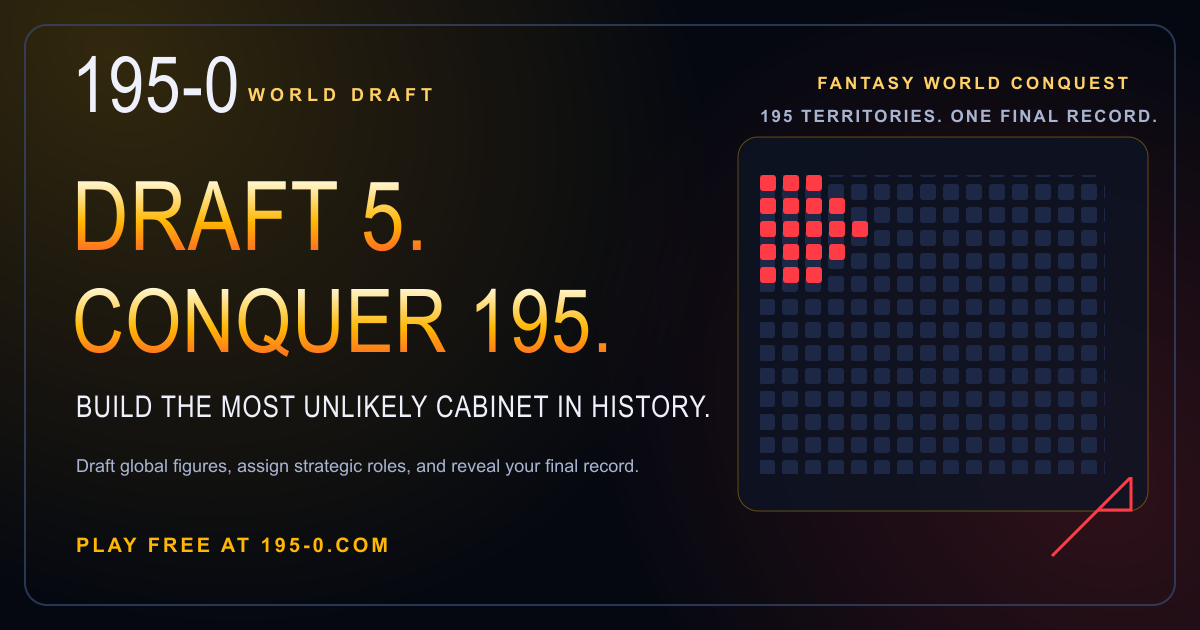
195-0 is a free browser strategy game built around a five-round draft. Each round combines a country with a profession or public-persona category, then offers a small pool of recognizable candidates. You pick one person and assign that person to one of five cabinet seats. When all five roles are filled, the game runs a fictional conquest simulation and gives the cabinet a score out of 195.
The joke is that the cabinet will rarely look sensible. A round might offer billionaires from Saudi Arabia, rappers from France, chefs from India, or pop stars from Kenya. The strategy comes from deciding whether a candidate is a natural fit for an open role or whether it is worth rerolling the country or category and hoping for a better pool. Fame alone is not enough: role fit, leadership, media reach, financial ability, international variety, and a small amount of randomness all influence the final result.
The cabinet's main authority figure. Political leadership, command experience, and broad public stature are useful signals.
A supporting role that rewards balance. It can absorb a versatile candidate when another seat has a clearer specialist.
The military seat. Commanders, soldiers, authoritarian leaders, and figures associated with conflict usually make more sense here.
A natural home for performers, broadcasters, writers, and media personalities with strong reach or storytelling ability.
Look for finance, business, political deal-making, or even criminal cunning. A wealthy candidate is useful only if this seat is still available.
My first round gave me Billionaires from Saudi Arabia. I chose Saleh Kamel and put him straight into the Treasurer seat. The screen initially said I was “Filling: President,” so I assumed the role order might be fixed, but the assignment dialog actually let me choose any open position. That was the first useful lesson: the round label shows the next empty seat, not a restriction. Saleh was too obvious a financial fit to waste elsewhere.
Round two was Rappers from France. I picked Orelsan for Propaganda Minister, which felt like another clean match. The trouble arrived immediately afterward. Round three opened with Indian Pop Stars, but my media role was already occupied. I rerolled the category and got TV Hosts—still media-heavy—then rerolled again and landed on Chefs. I chose Vikas Khanna as Vice President because his public profile and international work seemed more flexible than the other options. It was a compromise, not a confident appointment.
The fourth round made that earlier decision more expensive. I drew Swedish Pop Stars, rerolled into TV Hosts, then somehow landed back on Pop Stars. Changing the country produced a Kenyan pool. With only President and General left, none of the choices fitted neatly. I selected Eric Wainaina as President, hoping public stature would count for something. That is where I felt the draft's real pressure: a strong candidate can still be awkward when the correct chair is already taken.
The final round rescued the cabinet. Dictators from Azerbaijan gave me Mir Jafar Baghirov, whom I assigned as General. The finished lineup scored 146 out of 195 and earned the “Global Superpower” result. The game named the cabinet “The Gilded War Council,” marked Saleh Kamel as the MVP, and identified Vikas Khanna as the liability. That verdict matched how the draft had felt. The Treasurer decision was immediate and role-specific; the Vice President decision was made only because I had run out of better shapes for the puzzle.
What surprised me most was how much the order of the roles mattered. I began by treating each round as an isolated question—who is the best person in this group?—but the better question is what appointment keeps the remaining cabinet workable. Using Orelsan for propaganda was logical, yet it removed the easiest landing spot for several later entertainment categories. Respins helped, but they did not guarantee a useful alternative. The game is more interesting when I accept that uncertainty instead of rerolling until the cabinet looks artificially perfect.
| Feature | Classic Draft | Daily Challenge |
|---|---|---|
| Rounds | Five randomized rounds | The same five rounds for everyone |
| Respins | Country and category respins allowed | No respins |
| Replay | New combinations across drafts | Replay the shared daily puzzle |
| Competition | Experiment with cabinet ideas | Best verified result enters the daily leaderboard |
| Best for | Learning roles and trying unusual combinations | Comparing decisions on equal starting conditions |
Yes. The official site says the game runs in a browser without an account or download.
This is an independent guide page, not an embedded copy of the game.
There is no single permanent answer because the candidate pools and part of the simulation vary. Strong cabinets usually combine clear role matches with leadership, media, financial, and international balance.
Classic Draft lets you respin the country or category before viewing candidates. Daily Challenge locks all five rounds and does not allow respins.
No. The official scoring explanation says the simulation includes a small element of chance, so similar strategies can finish with different records.
More strategy games
Try another take on territory control, kingdom building, or army composition without leaving Game Collectors Top.